Content Marketing Services
Grow Your Business with freelance Content Marketing specialist & expert
Are you looking to attract more customers, build brand awareness, and grow your business online? Content marketing is one of the most effective digital marketing strategies for connecting with your target audience through valuable, relevant, and engaging content.
I’m Salma Ramees, a Freelance digital marketing Strategist in Bangalore and Palakkad, helping businesses develop effective content marketing strategies that improve online visibility, build brand trust, and support long-term business growth.
From creating SEO-friendly website content and informative blog articles to developing engaging social media content and compelling website copy, I help businesses communicate their brand message effectively and connect with potential customers.
Whether you are a startup, small business, entrepreneur, or established brand, I create customized content marketing strategies based on your business goals and audience requirements.
Let’s turn your content into a powerful tool for attracting customers and growing your brand!
What Is Content Marketing?

Content marketing is a strategic marketing approach that involves planning, creating, publishing, and distributing valuable content to attract and engage a clearly defined audience.
Instead of relying only on direct advertising, content marketing focuses on providing information that helps people understand their problems, explore possible solutions, and make informed decisions.
This content may include:
Website content and service pages
SEO blog articles
Educational guides and resources
Social media content
Landing page copy
Email newsletters
Case studies and success stories
Infographics and visual content
Product descriptions
Frequently asked questions
Video scripts and educational content
The purpose of content marketing is to build a meaningful relationship between your business and your audience.
When people consistently find useful information from your brand, they may begin to recognize your business as a reliable source. This familiarity can help strengthen trust and make your brand more memorable when they are ready to purchase a product or service.
Content marketing also supports other digital marketing activities. Search engine optimization helps people discover your content through search engines. Social media marketing helps distribute your content to relevant audiences. Email marketing allows you to share useful information directly with subscribers.
When these channels work together, content becomes an important part of your overall digital marketing strategy.
Why Content Marketing Is Important for Your Business
Every business has a story, a unique value proposition, and a set of solutions that can help its customers. However, simply having a good product or service does not guarantee that potential customers will discover or understand it.
Content marketing helps communicate what your business does, who it serves, and how it can solve customer problems.
1. Build Brand Awareness
Brand awareness is the foundation of a successful digital presence. Before customers choose your business, they need to know that it exists.
Content marketing helps introduce your brand to people who are searching for information related to your industry. Blog articles, educational resources, website content, and social media posts can help your business appear in relevant conversations.
When your content consistently addresses topics that matter to your audience, your brand becomes easier to recognize.
Instead of waiting for customers to discover your business through advertisements alone, you can create useful content that helps them find you while researching their needs.
2. Improve Search Engine Visibility
Search engines help people find answers to questions, compare options, and discover businesses. A well-planned content marketing strategy can support your website’s visibility by creating pages that address relevant search queries.
SEO content focuses on understanding what your audience searches for and providing a useful answer.
This may involve creating blog posts around industry questions, developing detailed service pages, improving existing website content, and building related articles around important topics.
Content marketing and SEO work best when they support each other. SEO helps identify opportunities for content, while quality content helps communicate relevance and usefulness to visitors.
3. Establish Brand Authority
Customers are more likely to consider businesses that demonstrate knowledge and understanding of their needs.
Publishing informative articles, practical guides, and industry-related resources gives your business opportunities to demonstrate its expertise.
Authority is not created by repeatedly claiming to be an expert. It is developed by consistently providing helpful information, explaining complex topics clearly, and demonstrating a genuine understanding of your audience.
Content marketing gives your business a platform to share that knowledge.
4. Generate Qualified Leads
Not every website visitor is ready to make a purchase immediately. Some visitors are researching a problem, while others are comparing service providers or evaluating different solutions.
Content marketing can support each stage of this decision-making process.
An educational article may attract someone who is just beginning their research. A detailed service page may help someone understand your offering. A case study or consultation page may encourage a visitor who is ready to discuss their requirements.
By creating content for different stages of the customer journey, your website can become more effective at attracting relevant visitors and encouraging meaningful inquiries.
5. Support Long-Term Marketing Growth
Advertising campaigns can generate visibility while they are active, but content can continue to provide value after publication.
A useful article may attract visitors over time, answer customer questions, support internal linking, and provide material for social media distribution.
This does not mean every article will generate traffic indefinitely. Content needs to be relevant, useful, maintained, and supported by an appropriate distribution strategy.
However, a strong content library can become a valuable long-term asset for your business.
Our Content Marketing Services
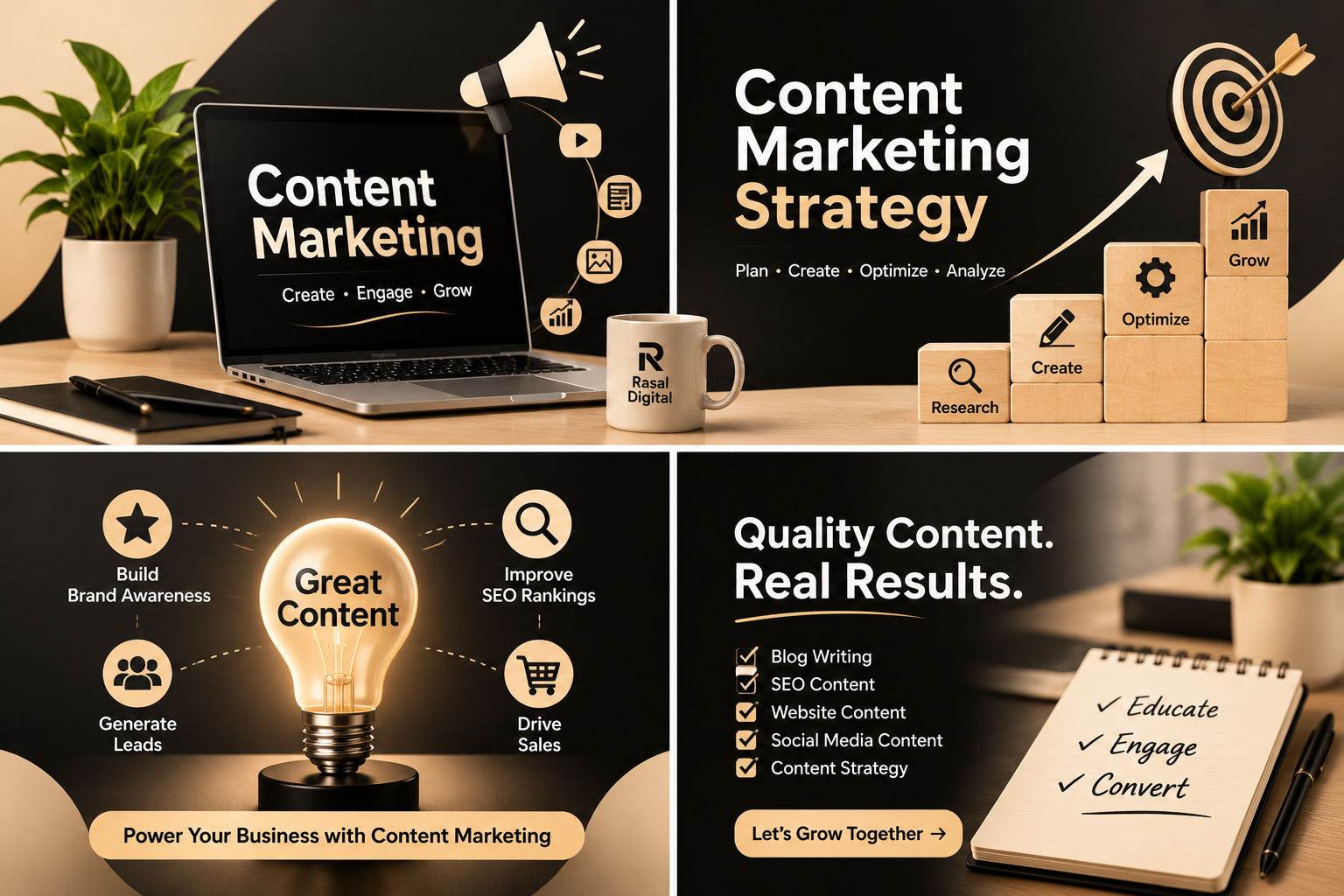
At Rasal Digital, content marketing can be developed around your business goals, audience needs, and digital marketing requirements.
The following services can help create a consistent and effective content strategy for your brand.
Content Strategy Development
A successful content marketing campaign begins with a clear strategy.
Without a strategy, businesses often publish content randomly. They may write about trending topics, create occasional blog posts, or share promotional messages without understanding how each piece supports their objectives.
Content strategy development helps establish a clear direction.
We can help identify your target audience, understand their interests, define content objectives, and plan topics that align with your business.
A content strategy may include:
Audience research
Content goals and objectives
Topic research
Keyword planning
Content format selection
Editorial calendar development
Content distribution planning
Performance measurement
The goal is to create a practical roadmap that helps your business publish content with purpose.
SEO Content Writing
SEO content writing combines useful information with search engine optimization principles.
The purpose is not to insert keywords into every paragraph. It is to create content that answers searchers’ questions while helping search engines understand the topic of your page.
Our SEO content writing approach can include keyword research, search intent analysis, heading structure, internal linking recommendations, title optimization, and relevant content development.
SEO content may be created for:
Website pages
Blog posts
Service pages
Landing pages
Educational resources
Industry guides
The focus is on creating clear, relevant, and informative content that supports your website’s search visibility and user experience.
Blog Writing Services
A business blog can be an effective way to share knowledge, answer customer questions, and develop a stronger online presence.
However, a successful blog requires more than publishing articles regularly. Each article should serve a specific purpose and provide information that readers can use.
Our blog writing services can help you develop content around your industry, products, services, and customer interests.
Blog topics may include:
Industry trends and developments
Educational articles
How-to guides
Frequently asked questions
Product and service explanations
Problem-solving resources
Comparison articles
Expert insights
A well-planned blog can support your content marketing strategy by addressing topics that are relevant to your audience and connected to your business.
Website Content Writing
Your website is often one of the first places potential customers visit when learning about your business.
The content on your website should explain your services clearly, communicate your value, and help visitors understand what to do next.
Website content writing focuses on creating informative and persuasive copy for important pages.
This may include:
Homepage content
About page content
Service page content
Landing page copy
Contact page content
Frequently asked questions
Website introductions and descriptions
Good website content should be easy to understand, well organized, and focused on the needs of your visitors.
It should communicate your business message without unnecessary complexity.
Landing Page Content
Landing pages are designed to support a specific marketing objective.
A landing page may promote a service, introduce an offer, encourage consultation requests, or guide visitors toward a particular action.
Effective landing page content explains the problem, introduces the solution, highlights relevant benefits, and provides a clear next step.
We can help develop landing page copy that aligns with your campaign and audience.
The content may include:
A clear headline
A supporting introduction
Service benefits
Key features
Trust-building information
Frequently asked questions
A call to action
The goal is to make the page relevant to the visitor and easy to navigate.
Content Optimization
Your existing content may already contain useful information, but it may need improvement to remain relevant and effective.
Content optimization involves reviewing published pages and identifying opportunities to improve clarity, structure, usefulness, and search relevance.
This may include:
Updating outdated information
Improving headings
Refining introductions
Adding missing information
Improving readability
Strengthening internal links
Updating calls to action
Removing unnecessary repetition
Content optimization can help your existing content serve visitors more effectively.
Social Media Content
Social media content allows your business to communicate with audiences across digital platforms.
A content marketing strategy can include social media posts that educate, inform, entertain, or encourage discussion.
Social media content may include:
Educational posts
Short tips
Industry insights
Brand updates
Promotional content
Content summaries
Campaign messages
Community-focused posts
Social media can also help distribute your website content and introduce your articles to people who may not discover them through search engines.
Email Content Marketing
Email marketing provides a direct way to communicate with people who have chosen to receive updates from your business.
Useful email content can help maintain relationships, share new resources, introduce services, and keep your audience informed.
Email content may include newsletters, educational messages, blog updates, product announcements, and campaign-related communication.
A thoughtful email content strategy focuses on relevance and value rather than sending frequent promotional messages without a clear purpose.
Content Repurposing
Creating high-quality content requires time and effort. Content repurposing helps you make better use of the information you already have.
For example, a detailed blog article can be adapted into:
Multiple social media posts
A short email newsletter
An infographic outline
A video script
A carousel post
A downloadable checklist
A presentation
Repurposing allows your business to communicate the same core ideas in different formats while adapting the message to each platform.
It also helps maintain consistency across your digital marketing channels.
Our Content Marketing Process
A structured process helps ensure that content is relevant, consistent, and aligned with your business objectives.
Step 1: Understand Your Business
Before creating content, it is important to understand your business, services, audience, and goals.
We begin by identifying what your business offers, what makes it different, and what you want your content marketing to achieve.
This may involve understanding your target customers, service areas, industry, brand voice, and existing digital presence.
The better we understand your business, the easier it becomes to create content that communicates your value clearly.
Step 2: Research Your Audience
Content should be created around the needs of your audience.
We consider the questions your potential customers ask, the problems they face, the information they need, and the factors that influence their decisions.
Audience research may include reviewing customer questions, analyzing relevant search queries, studying competitor content, and identifying common industry topics.
This research helps create content that is useful and relevant instead of relying only on assumptions.
Step 3: Develop a Content Strategy
Once the audience and business objectives are understood, the next step is to develop a content strategy.
The strategy defines the topics, formats, priorities, and publishing direction for your content.
It may include content categories, keyword opportunities, blog topics, service page improvements, and a content calendar.
A clear strategy helps your business maintain focus and avoid publishing content without a purpose.
Step 4: Create the Content
Content creation involves developing the actual material based on the agreed strategy.
Each piece of content should have a clear objective, a defined audience, and a useful message.
The writing process focuses on clarity, structure, relevance, and brand consistency.
Depending on the content type, this may involve writing an article, developing a service page, preparing landing page copy, or creating social media content.
Step 5: Optimize and Review
Before publication, content should be reviewed for accuracy, readability, structure, and relevance.
SEO considerations may include title tags, headings, internal links, keyword alignment, and meta descriptions.
The review process also helps identify unnecessary repetition, unclear statements, and opportunities to improve the reader’s experience.
Step 6: Publish and Distribute
Publishing content is only one part of the process.
Content distribution helps introduce your content to the audience it was created for.
Depending on your strategy, distribution may include search engine visibility, social media sharing, email newsletters, and relevant promotional channels.
The most suitable distribution methods depend on your audience, content type, and marketing objectives.
Step 7: Measure and Improve
Content marketing should be evaluated based on meaningful business and audience outcomes.
Depending on your goals, useful metrics may include:
Organic search traffic
Search impressions
Search clicks
Engagement with content
Time spent on important pages
Newsletter subscriptions
Qualified inquiries
Conversion rate
Content-assisted conversions
Measurement helps identify what is working, what needs improvement, and which content opportunities deserve more attention.
Content Marketing for SEO
Search engine optimization and content marketing are closely connected.
SEO helps your content become discoverable through relevant search queries. Content marketing helps provide the information people are looking for.
When both are planned together, your website can develop a stronger structure around important topics.
Keyword Research and Search Intent
Keyword research helps identify the words and phrases people use when searching for information related to your business.
However, keyword research should go beyond search volume.
It is important to understand the intent behind a search.
A person searching for “what is content marketing” may want an explanation. Someone searching for “content marketing services” may be comparing providers. A person searching for “content marketing agency pricing” may be evaluating their budget.
Understanding search intent helps determine the right type of content for each topic.
Topic Clusters and Content Hubs
A topic cluster is a group of related content pieces organized around a central subject.
For example, a content marketing topic hub may include articles about content strategy, SEO writing, blog planning, content distribution, and content performance.
A central page can introduce the main topic and link to supporting articles that explore specific areas in greater detail.
This structure helps readers discover related information and allows search engines to understand the relationship between your pages.
Internal Linking
Internal links connect one page of your website to another.
They help visitors navigate your content and discover related services or resources.
For example, a blog article about SEO content writing may link to your content marketing service page. A content strategy guide may link to related articles about blog planning and keyword research.
Internal links should be relevant and helpful. They should guide readers toward information that supports their needs.
Content Quality and Relevance
Search optimization should not come at the expense of content quality.
A page should answer its main question clearly and provide enough information for the reader to understand the topic.
Avoid adding unnecessary paragraphs simply to make an article longer. Avoid repeating keywords in ways that make the writing unnatural.
The best approach is to create content that serves a genuine purpose and supports the overall experience of your website visitors.
Content Marketing for Small Businesses
Small businesses often compete with larger companies that have more marketing resources.
Content marketing provides an opportunity to communicate expertise, build relationships, and attract relevant audiences through useful information.
A small business does not need to publish content on every possible topic.
Instead, it can focus on a few important areas where it has genuine knowledge and where customers need help.
For example, a local service business may create content explaining common customer problems, service options, maintenance tips, and frequently asked questions.
A professional service provider may publish articles that explain industry concepts, common challenges, and practical solutions.
A small business can also use its existing customer knowledge to create content that answers real questions.
The key is consistency, relevance, and usefulness.
Content Marketing for Startups
Startups need to introduce their brand, explain their offering, and help potential customers understand why their solution matters.
Content marketing can support these objectives by creating educational and product-related content.
A startup content strategy may include:
Brand introduction content
Product or service explanations
Educational blog articles
Problem-solving guides
Comparison content
Founder or team insights
Customer onboarding resources
The content should help people understand the problem your business solves and how your offering fits into their needs.
Startups can begin with a focused content plan and expand it as their audience and business objectives develop.
Content Marketing for B2B Businesses
Business-to-business marketing often involves longer decision-making processes and multiple stakeholders.
Potential clients may need detailed information before choosing a service provider or purchasing a solution.
Content marketing can help B2B businesses explain complex offerings in a clear and practical way.
Useful B2B content may include:
Industry guides
Educational articles
Case studies
Service explanations
Comparison resources
Frequently asked questions
Research-based insights
Professional newsletters
B2B content should address the practical concerns of decision-makers, such as efficiency, quality, reliability, business requirements, and implementation.
By providing useful information throughout the buying journey, businesses can help potential clients make more informed decisions.
Content Marketing for Local Businesses
Local businesses can use content marketing to communicate with customers in specific locations.
Local content may include information about services, customer needs, frequently asked questions, and topics relevant to the local community.
For example, a local business may create articles explaining how its services work, what customers should consider before choosing a provider, and how to prepare for a service appointment.
Local content should be genuinely relevant to the area and audience.
Simply adding city names to generic articles does not create meaningful local value.
A thoughtful local content strategy focuses on helping nearby customers understand your business and the services you provide.
Different Types of Content That Support Business Growth
Content marketing includes many formats, and each format serves a different purpose.
Educational Blog Articles
Educational articles explain topics that matter to your audience.
They can help readers understand a problem, explore a solution, or learn how something works.
A useful article should have a clear focus and provide information that readers can apply.
Detailed Guides
Guides provide more comprehensive information about a specific topic.
They may explain a process, compare options, or help readers complete a task.
Guides can become valuable resources when they are organized clearly and maintained over time.
Case Studies
Case studies explain how a business approached a particular challenge and what happened as a result.
They can help potential customers understand your working process and the type of value your services may provide.
A credible case study should use accurate information and clearly explain the context of the results.
Infographics
Infographics present information visually.
They can help communicate processes, comparisons, statistics, and key ideas in an easy-to-understand format.
Infographics are particularly useful when a topic can be explained through a clear visual structure.
Video Content
Video content can demonstrate products, explain services, answer questions, and communicate brand personality.
Videos may be used on websites, social media platforms, landing pages, and educational resource pages.
Email Newsletters
Newsletters allow businesses to share useful information with subscribers.
They can include articles, industry updates, educational tips, and relevant announcements.
The most effective newsletters provide a reason for readers to continue opening and engaging with them.
How Content Marketing Builds Customer Trust
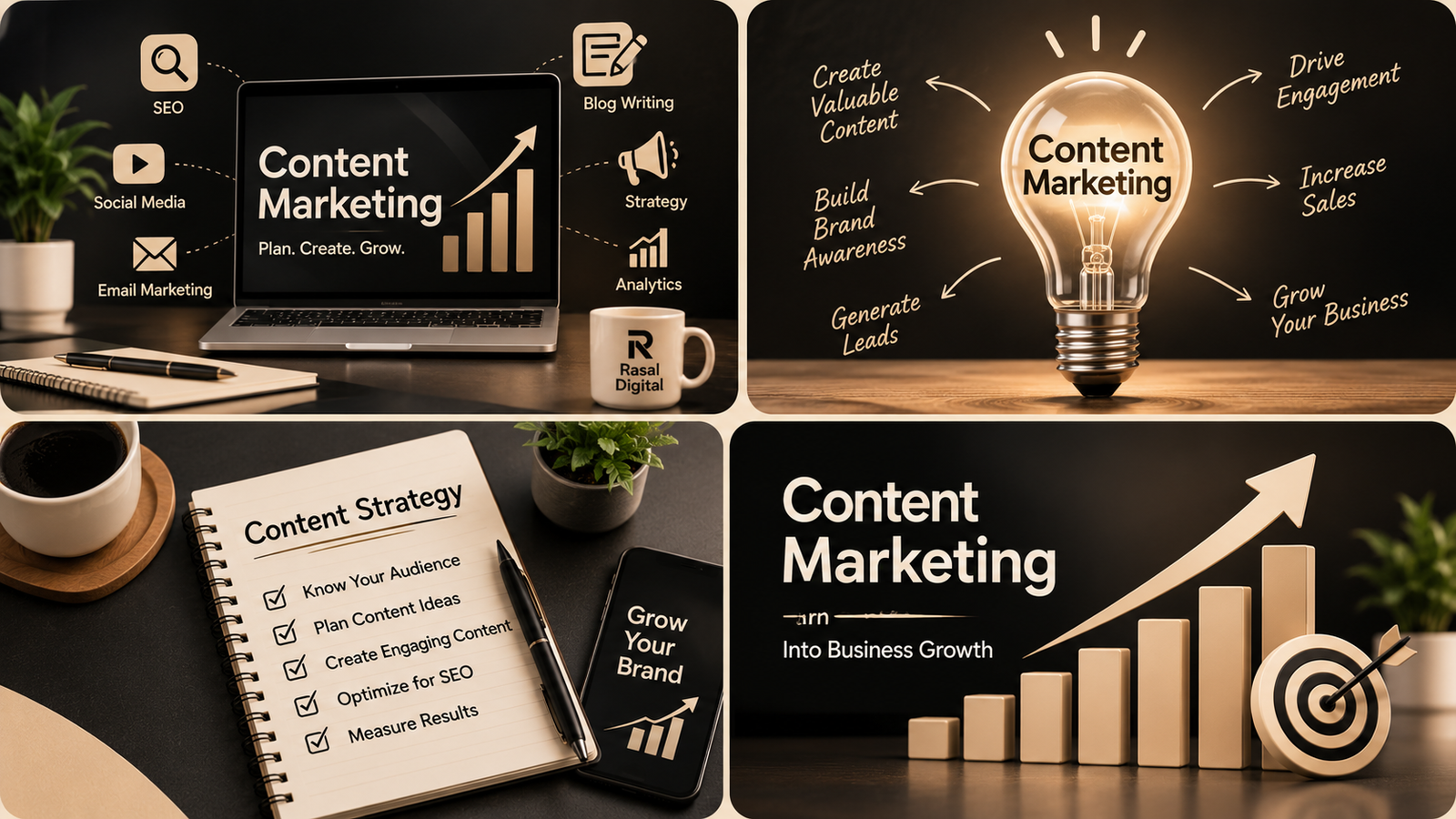
Trust is an important factor in customer decision-making.
People want to understand whether a business can provide the solution they need. They may look for evidence of knowledge, clear communication, relevant experience, and reliable information.
Content marketing helps demonstrate these qualities.
When your website answers questions clearly, explains services honestly, and provides useful resources, visitors can develop a better understanding of your business.
Trust can also be strengthened by including accurate business information, genuine testimonials, real case studies, clear service details, and transparent communication.
Content should never rely on fabricated reviews, misleading claims, or unrealistic promises.
A trustworthy content strategy focuses on helping people make informed decisions.
Common Content Marketing Mistakes to Avoid
Content marketing can become ineffective when it is developed without a clear purpose.
Here are some common mistakes businesses should avoid.
Publishing Without a Strategy
Publishing content randomly can make it difficult to build a consistent message.
A content strategy helps identify priorities and ensures that each piece supports a broader objective.
Writing Only for Search Engines
Content should not be created simply to include keywords.
Search optimization is important, but the content must also provide a useful experience for readers.
Ignoring the Audience
Content that focuses only on the business’s products or achievements may fail to address customer needs.
A better approach is to understand the audience’s questions and provide relevant information.
Inconsistent Publishing
Publishing content occasionally can make it difficult to maintain momentum.
A realistic content calendar helps businesses plan around their available resources and maintain a manageable publishing schedule.
Neglecting Existing Content
Older content may contain outdated information or no longer reflect your services.
Regular content reviews help keep important pages accurate and useful.
Failing to Measure Performance
Without measurement, it can be difficult to understand whether your content supports your goals.
Tracking relevant metrics helps guide future improvements.
How to Measure Content Marketing Success
Content marketing results should be evaluated according to the objectives of your business.
A campaign designed to improve brand awareness may focus on reach, impressions, and audience engagement.
A campaign designed to attract search traffic may focus on organic clicks, search impressions, and relevant landing page visits.
A campaign designed to generate leads may focus on qualified inquiries, form submissions, consultation requests, and conversion rates.
It is important to understand that content marketing results can take time.
Some content may begin attracting attention quickly, while other content may require updates, distribution, and ongoing optimization.
The purpose of measurement is not simply to report numbers. It is to understand how content contributes to your marketing objectives and where improvements can be made.
Why Choose Rasal Digital for Content Marketing?
Choosing the right content marketing partner can help your business develop a clearer content strategy and maintain a consistent digital presence.
At Rasal Digital, the focus is on creating content that communicates your business message, supports your marketing objectives, and provides value to your audience.
Content marketing should be connected to your business—not treated as an isolated activity.
A thoughtful content approach considers your audience, brand positioning, website structure, search visibility, and customer journey.
Whether you need website content, SEO blog articles, landing page copy, or a broader content strategy, the work should begin with understanding what your business needs to communicate.
Our content marketing approach emphasizes:
Business-Focused Content
Content should support your business objectives and communicate the value of your services.
Audience-Centered Writing
The content should address the questions, interests, and concerns of your target audience.
Clear Communication
Your message should be easy to understand, relevant, and organized logically.
SEO-Friendly Structure
Content can be planned with search intent, headings, relevant keywords, and internal linking in mind.
Consistent Brand Voice
Your website and marketing content should communicate a recognizable and consistent brand personality.
Continuous Improvement
Content can be reviewed and improved based on audience response, business goals, and performance data.
Start Building a Stronger Content Marketing Strategy
Your content is an important part of how people discover, understand, and evaluate your business.
A well-planned content marketing strategy can help you communicate your expertise, answer customer questions, improve your digital presence, and create more meaningful opportunities for engagement.
The first step is understanding what your audience needs and how your business can provide useful information.
From there, you can develop a content plan that supports your website, SEO, social media, and broader marketing objectives.
At Rasal Digital, we can help you create content that reflects your brand, supports your goals, and gives your audience a reason to engage.
If you are ready to strengthen your online presence with purposeful content, explore our content marketing services and get in touch to discuss your requirements.
Let’s create content that communicates your value, connects with your audience, and supports your business growth.
Frequently Asked Questions About Content Marketing
What is content marketing, and how does it work?
Content marketing is the process of creating and distributing valuable information to attract and engage a target audience.
It works by helping people discover your business, understand your services, and find answers to their questions.
Content may be published through websites, blogs, social media, email newsletters, and other digital channels.
Why does my business need content marketing?
Content marketing can help your business improve online visibility, communicate expertise, answer customer questions, and support lead generation.
It also provides useful information that may help potential customers understand your services before contacting you.
Is content marketing important for SEO?
Yes. Content marketing and SEO can support each other.
SEO helps identify relevant search opportunities, while content provides information that helps visitors and search engines understand your website.
However, content should be useful and relevant rather than created only to target keywords.
How often should I publish content?
The ideal publishing frequency depends on your business goals, resources, audience, and content type.
A consistent and realistic schedule is usually more manageable than publishing large amounts of content without sufficient planning.
How long does content marketing take to show results?
Content marketing does not have a fixed timeline for results.
Performance depends on factors such as competition, content quality, website visibility, audience demand, and distribution.
Some content may attract engagement soon after publication, while other content may need ongoing optimization and promotion.
What types of content should my business create?
The most suitable content depends on your audience and objectives.
Common formats include blog articles, website pages, educational guides, social media posts, landing pages, email newsletters, and case studies.
A content strategy helps determine which formats are most appropriate.
Can content marketing help generate leads?
Yes. Content marketing can support lead generation by attracting relevant visitors and helping them understand your services.
Educational articles, service pages, case studies, and landing pages can guide visitors toward actions such as requesting a consultation or contacting your business.
What is the difference between content marketing and content writing?
Content writing is the process of creating written material.
Content marketing is a broader strategy that includes planning, creating, publishing, distributing, and measuring content to achieve business objectives.
Content writing is an important part of content marketing, but content marketing also involves strategy and promotion.
Do you provide SEO content writing services?
SEO content writing can be included as part of a content marketing strategy.
It involves creating useful content while considering search intent, keyword relevance, page structure, and other SEO best practices.
Can content marketing help small businesses?
Yes. Content marketing can help small businesses communicate their expertise, answer customer questions, and develop a stronger online presence.
Small businesses can begin with a focused strategy and create content around the topics most relevant to their customers.
What is a content marketing strategy?
A content marketing strategy is a plan that defines what content your business should create, who it should serve, where it should be published, and how its performance will be evaluated.
It helps ensure that content supports your business objectives rather than being published randomly.
How can I get started with content marketing?
Start by identifying your business goals and understanding your target audience.
Then research relevant topics, develop a content plan, create useful content, distribute it through appropriate channels, and review its performance.
A clear strategy can help you build a more consistent and effective content marketing process.
Ready to Grow Your Business With Content Marketing?
Your audience is searching for information, exploring solutions, and comparing businesses every day.
Make your brand part of that journey with useful, relevant, and purposeful content.
Contact Rasal Digital to discuss your content marketing requirements and build a strategy that supports your business goals.